
Rethinking the Built Environment in a Resource-Constrained World
The built environment is one of the most visible expressions of human development. It is also among the most resource- and carbon-intensive sectors on the planet. Globally, it accounts for more than 50% of resource extraction, nearly 40% of greenhouse gas emissions, and about 30% of total waste generation. Yet, the dynamics of construction, urbanisation, and resource use differ profoundly between regions.
In the Global North, the built environment is largely established. The primary challenge lies in transforming existing infrastructure, adapting, retrofitting, and extending the life of what is already built, while minimising further material and carbon footprints. Here, reducing growth in floor area and enhancing quality of life without increasing consumption is key.
In contrast, the Global South is experiencing rapid urban growth. By 2050, over 2.5 billion people will require new housing and infrastructure. In Africa, an estimated 80% of buildings that will exist by mid-century have yet to be constructed. This is a key opportunity to shift toward low-carbon, inclusive, and resource-efficient construction practices before unsustainable models take hold.

Purpose and Goals
This session aims to foster dialogue on how international cooperation, governance, finance, and innovation can align to support context-sensitive solutions that are also globally coherent.
Topics for Discussion
What are the most promising pathways for the Global South to build inclusive, resilient, and low-carbon infrastructure at scale?
How can sustainable construction materials—such as timber hybrids, bio-based products, low-carbon materials—be scaled in both high- and low-income settings?
- How can international finance and technology transfer support local priorities without reinforcing inequalities?
How can multilateral governance, technology transfer, and international frameworks support a just and sustainable built environment globally?
As regulatory frameworks are being shaped and exploration licenses already granted, it is crucial to ask: Can we build a future that is both livable and sustainable—for everyone, everywhere?
About the Panel
This session will bring together global voices to explore equitable and sustainable strategies for the built environment across different development contexts.
Panelists:
Nasra Nanda – CEO, Kenya Green Building Society
Paola Deda – Director of the Forests, Land and Housing Division, UN Economic Commission for Europe (UNECE)
Hubert Rhomberg – Founder and CEO, CREE Buildings
Karen Scrivener – Prof. Construction Materials, EPFL University
Peter Richner – Former Deputy Director, Swiss Federal Laboratories for Materials Science and Technology (EMPA)
Moderated by:
Mona Mohammed, Programme Management Officer, Life Cycle Initiative, UN Environment Programme (UNEP)
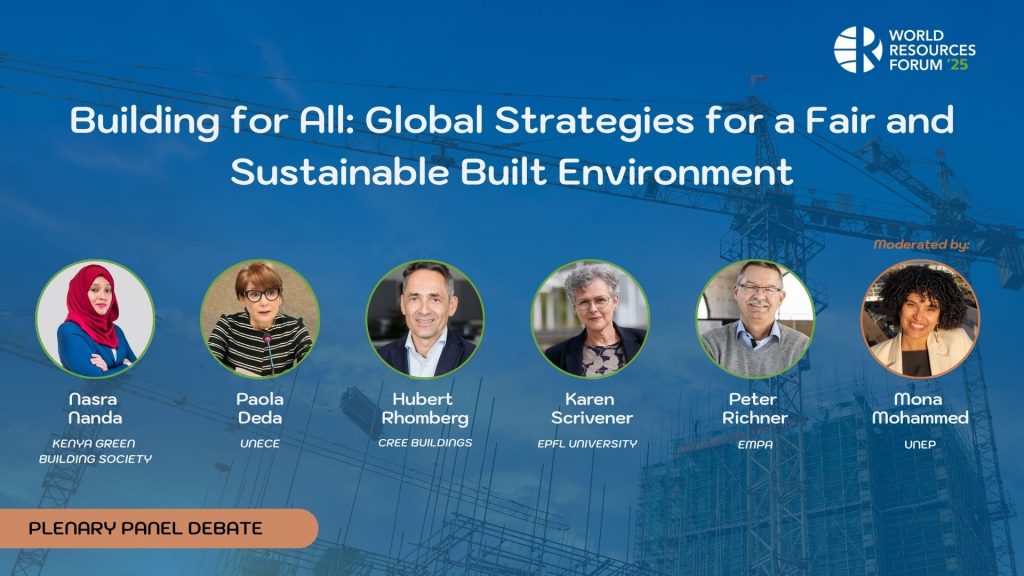
Join us at WRF25 for this high-level panel on the future of our built environment. Explore how bold, regionally responsive strategies—grounded in equity, circularity, and climate resilience—can shape the buildings, cities, and infrastructure of tomorrow.